For appointments: +91 96716 00470 | +91 86195 19149
Monday - Saturday: 9:00am - 8:00pm
A missing tooth can affect more than your smile. You may find it uncomfortable to chew certain foods, feel conscious while speaking, or notice that you avoid smiling in photographs. If you have lost a tooth because of decay, gum disease, an injury, or another dental problem, replacing it may help restore your oral function and confidence.
Dental implants are one option for replacing missing teeth. They use a small implant placed in the jawbone to support a replacement tooth, bridge, or full-arch restoration, depending on the number of teeth being replaced and the patient's oral health.
At Dr. Gourav Dental Art in Karnal, Haryana, patients can seek a dental consultation to understand their tooth replacement options and whether implant treatment may be appropriate for their needs.
Every patient has a different dental history. The right approach depends on factors such as the condition of the gums, available jawbone, overall health, number of missing teeth, and personal treatment preferences.
If you are considering dental implants in Karnal, understanding the procedure, recovery, expected costs, benefits, and limitations can help you have a more informed discussion with your dentist.
A dental implant is a medical device placed in the jawbone to support a replacement tooth. Most conventional dental implants are made from titanium or titanium alloys, although other materials are also available.
Unlike a removable denture, an implant is designed to provide a fixed foundation for a replacement tooth. Once healing and integration with the bone have progressed sufficiently, the implant can support a crown, bridge, or other suitable restoration.
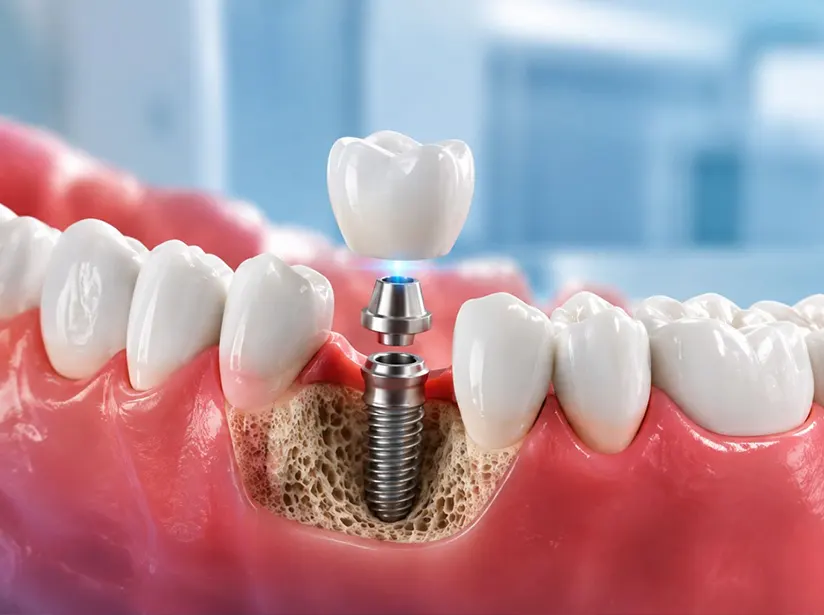
A conventional dental implant restoration generally consists of three components:
1. Dental implant: This is the component placed in the jawbone. It serves as an artificial tooth root and provides support for the replacement tooth.
2. Abutment: This connects the implant to the crown or other restoration.
3. Dental crown: This is the visible replacement tooth. It is designed to restore the appearance and function of the missing tooth.
The exact arrangement varies according to the treatment plan. For example, a person missing several teeth may need a bridge supported by implants rather than an individual implant for every missing tooth.
Dental implants are not suitable for every patient, and their long-term success depends on appropriate case selection, treatment planning, oral hygiene, and regular professional monitoring.
Dental implant treatment may be considered for adults who have lost one or more teeth and want to explore a fixed replacement.
You may wish to discuss dental implants with a dentist if:
However, having a missing tooth does not automatically mean that an implant is the best option.
Your dentist will assess the condition of your remaining teeth, gums, jawbone, bite, and general health before recommending treatment. A dental bridge or removable denture may be more appropriate in some situations.
The purpose of a consultation is to understand your needs and identify a treatment option that is clinically suitable for you.
Dental implant treatment can be planned in different ways depending on how many teeth are missing, where the gaps are located, and the condition of the supporting bone.
A single tooth implant may be considered when one tooth is missing.
The implant is placed in the jawbone and, after the appropriate healing period, supports a custom-made crown. The crown is designed to fit the space and complement the surrounding teeth.
One potential advantage is that a conventional implant-supported crown does not require the adjacent teeth to be prepared in the same way as a traditional tooth-supported bridge.
However, implant treatment requires a suitable site and careful planning. Your dentist will evaluate the gap, gum condition, bone availability, and bite before deciding whether this option is appropriate.
If you are missing several teeth, your dentist may recommend a combination of implants and a fixed bridge.
The number of implants required depends on the location and size of the gap, bone conditions, the forces placed on the teeth, and the design of the restoration.
Replacing several missing teeth does not always require one implant for each tooth. In suitable cases, multiple replacement teeth can be supported by fewer implants through a carefully planned bridge.
The final treatment plan should explain the proposed number of implants, type of restoration, expected stages, and associated costs.
Patients who are missing most or all teeth in an upper or lower jaw may be able to explore implant-supported full-arch restorations.
These treatments use strategically placed implants to support a complete set of replacement teeth. The number and position of implants depend on the patient's anatomy, bone condition, bite, and restorative requirements.
Full-arch treatment is more complex than replacing a single tooth. It may involve additional diagnostic investigations, surgical planning, temporary teeth, and a carefully designed final restoration.
Not every patient is a suitable candidate. A detailed assessment is necessary to understand the available options, expected maintenance, and financial commitment.
In selected cases, an implant may be placed during the same appointment as a tooth extraction.
This is known as immediate implant placement. It is not suitable for every extraction site.
The decision depends on factors such as infection, bone condition, the tissues surrounding the tooth, and whether the implant can be placed with adequate stability.
It is also important to distinguish immediate placement from immediate loading. Placing an implant on the day of extraction does not necessarily mean that the final replacement tooth can be attached and used immediately.
Your dentist should explain which approach, if any, is appropriate for your individual case.
Dental implants may offer several advantages when they are appropriately planned and maintained.
An implant-supported crown or bridge is designed to remain in place during normal use. Unlike a removable denture, it does not need to be taken out for routine cleaning, although the area around the restoration requires careful daily hygiene.
Missing teeth can make certain foods difficult to chew. A suitable implant-supported restoration can help restore chewing function, although the result depends on the location of the missing teeth, the bite, and the overall dental condition.
The visible crown is made to complement the surrounding teeth in shape, size, and colour. The final appearance depends on the available space, gum tissues, bone structure, and the design of the restoration.
A conventional implant-supported crown can replace a missing tooth without requiring the neighbouring healthy teeth to be prepared as bridge abutments.
This can be an important consideration when comparing implants with traditional bridges. However, implants involve a surgical procedure, whereas a conventional bridge does not require implant placement.
After tooth loss, the jawbone in the area may gradually change because it no longer receives the same stimulation from the missing tooth root.
Implants can help provide functional stimulation to the surrounding bone. However, they do not guarantee that all bone loss will be prevented, and existing bone deficiencies may require additional treatment.
Dental implants are designed for long-term use, but they are not maintenance-free.
The implant, surrounding gums, and replacement crown need regular monitoring. The crown may wear, chip, or require replacement, while the implant itself can develop complications if the surrounding tissues become unhealthy.
Your dentist can explain the likely maintenance requirements for your proposed restoration.
Understanding the stages of treatment can make it easier to prepare for a dental implant consultation.
The exact process varies from patient to patient, but conventional implant treatment generally involves the following steps.
The first step is to assess your missing tooth or teeth and discuss what you want to achieve through treatment.
Your dentist will review your dental history, examine your mouth, and ask about relevant medical conditions and medications.
The assessment may include checking the gums, remaining teeth, bite, and the space available for the replacement tooth.
This visit is also an opportunity to discuss the advantages, limitations, alternatives, estimated costs, and expected duration of treatment.
Dental imaging helps the dentist assess the proposed implant site.
Depending on the case, this may involve conventional dental X-rays or three-dimensional imaging, such as cone-beam computed tomography (CBCT), when clinically indicated.
Imaging can help assess the available bone and the relationship of the proposed implant site to important anatomical structures.
The dentist then develops a treatment plan based on the examination and diagnostic findings.
Additional procedures, such as bone grafting or treatment for gum disease, may be necessary before implant placement in some cases.
Before surgery, the dentist will explain the procedure, anaesthesia options, expected recovery, and instructions for the day of treatment.
Any active oral infection or gum disease should be assessed and managed appropriately.
Medical conditions and medications that could affect healing also need to be considered. Do not stop prescribed medication unless the clinician responsible for your care advises you to do so.
During implant surgery, the dentist places the implant into the planned position in the jawbone using an appropriate surgical technique.
Local anaesthesia is commonly used to reduce pain during the procedure. Depending on the clinical situation, other approaches to managing anxiety or discomfort may be discussed.
Some soreness, swelling, or minor bleeding can occur after surgery. The amount of discomfort varies, and your dentist will provide instructions for managing recovery.
It is important to follow the postoperative instructions and attend the recommended follow-up appointments.
After placement, the implant generally needs time to integrate with the surrounding bone. This process is called osseointegration.
Healing time varies according to the implant site, bone quality, the patient's health, and whether additional procedures have been performed.
Some patients may receive a temporary replacement tooth during healing, while others may need to wait before a temporary or final restoration can be attached.
The dentist will determine when the implant is ready for the next stage rather than relying on a fixed timeline for every patient.
Once the implant is sufficiently stable and the tissues have healed as planned, the dentist proceeds with the restorative stage.
An abutment connects the implant to the replacement crown. The crown is designed to fit the gap and function with the surrounding teeth.
The dentist checks the fit, appearance, bite, and comfort of the restoration and makes any necessary adjustments.
The aim is to provide a replacement that functions appropriately and can be maintained through regular oral hygiene.
Dental implant treatment does not end when the crown is fitted.
Regular check-ups allow the dentist to assess the implant, surrounding gums, bone support, bite, and condition of the restoration.
You will also receive guidance on cleaning around the implant and identifying changes that need professional attention.
Maintaining these appointments is an important part of protecting your investment in treatment.
The total time required for dental implant treatment depends on the patient's condition and the planned procedure.
Some straightforward cases can progress relatively quickly, while others require several months of healing or additional procedures.
Factors that may affect treatment duration include:
A temporary restoration may be possible in selected cases, but it is not appropriate for everyone.
During your consultation, ask for an estimated treatment timeline that identifies the major stages, expected review appointments, and circumstances that could delay completion.
It is normal to feel concerned about discomfort before a dental procedure.
During implant placement, local anaesthesia is commonly used to reduce pain. You may still notice pressure or movement during parts of the procedure.
After the anaesthesia wears off, some soreness, swelling, tenderness, or bruising may occur. These symptoms vary according to the complexity of the surgery and individual healing.
Your dentist will explain how to manage discomfort and which medications, if any, are appropriate for you.
Follow the prescribed or recommended instructions rather than taking medication without checking whether it is suitable for your medical history.
Contact your dental clinic if pain or swelling becomes worse instead of improving, or if you experience other concerning symptoms after treatment.
Dental implants may be appropriate for many adults with missing teeth, but suitability must be assessed individually.
Several factors influence whether treatment can proceed safely and predictably.
Healthy gums and appropriate management of periodontal disease are important for implant treatment.
Existing gum disease should be assessed because inflammation and poor periodontal health can affect the tissues supporting natural teeth and implants.
The implant requires adequate bone support.
If there is insufficient bone, additional treatment may be considered in selected cases. Whether this is appropriate depends on the amount and location of the bone deficiency and the overall treatment plan.
Certain medical conditions and treatments can influence healing or the risk of complications.
Your dentist should review your relevant medical history and medications before recommending surgery.
Smoking can affect oral healing and is associated with an increased risk of implant complications.
If you smoke or use tobacco, discuss this openly with your dentist. They can explain how it may affect treatment and what steps may reduce risk.
Implants need daily cleaning and ongoing professional monitoring.
Patients should understand the importance of maintaining the restoration and attending regular reviews before deciding on treatment.
Implants are generally planned after jaw growth has been completed. The appropriate timing depends on individual development and clinical circumstances.
A dental consultation is the best way to determine which replacement options are suitable for your situation.
Dental implants can be useful, but they are not always the first or most appropriate choice.
Your dentist may recommend treating gum disease first, improving oral hygiene, reviewing a medical condition, or considering another type of tooth replacement.
An implant may also be less suitable if the available bone, anatomical conditions, or expected maintenance requirements do not support a reasonable treatment plan.
Alternatives may include:
Each option has its own advantages, limitations, costs, and maintenance requirements.
A good treatment discussion should explain why a particular option is being recommended and what alternatives are available.
If you have missing teeth, it can be difficult to decide which replacement option to consider.
The following comparison explains the main differences. The most suitable choice depends on your dental examination and treatment goals.
| Feature | Dental Implants | Conventional Dental Bridge | Removable Denture |
|---|---|---|---|
| How it works | Implant supports a crown, bridge, or other restoration | Replacement teeth are supported by prepared natural teeth | Replacement teeth rest on the gums and may use remaining teeth for support |
| Removable | Generally fixed | Fixed | Removable |
| Surgery | Implant placement involves surgery | Usually does not require implant surgery | Usually does not require implant surgery |
| Effect on adjacent teeth | An implant-supported crown can avoid preparing neighbouring teeth | Supporting teeth generally need preparation | Depends on the design and remaining teeth |
| Bone considerations | Requires assessment of the proposed implant site and bone support | Does not replace the missing tooth root | Does not replace the missing tooth root |
| Maintenance | Daily cleaning and professional monitoring | Daily cleaning, including beneath the bridge | Daily cleaning and periodic assessment of fit |
| Suitability | Depends on bone, gums, health and treatment goals | Depends on the condition and suitability of supporting teeth | Depends on the number of missing teeth and oral conditions |
No single option is best for everyone. Your dentist can explain the likely benefits, limitations, and long-term maintenance requirements of each approach.
One of the most common questions patients ask is, "How much does a dental implant cost in Karnal?"
There is no single price that applies to every patient. The total cost depends on the type of replacement required, the condition of the mouth, the materials selected, and the procedures involved.
A consultation helps determine which treatment components are necessary and what the complete estimated cost will be.
Replacing one tooth generally involves a different treatment plan from replacing several teeth or an entire dental arch.
The implant system, abutment, and material selected for the final crown can influence the overall cost.
Some patients have sufficient bone for implant placement, while others may need additional procedures. These requirements can affect the total cost and treatment timeline.
If gum disease, infection, or another dental problem needs attention before surgery, the overall treatment plan may involve additional costs.
A single crown, an implant-supported bridge, and a full-arch restoration differ in complexity and materials.
The treatment estimate should clarify which examinations, imaging procedures, reviews, and maintenance appointments are included.
Before agreeing to treatment, ask for a written estimate that clearly explains:
At Dr. Gourav Dental Art, patients can contact the clinic in Karnal to discuss their dental concerns and arrange a consultation about available treatment options.
The final treatment recommendation and cost should be provided after the relevant clinical assessment. This allows you to understand what is being proposed before making a decision.
Following the dentist's postoperative instructions is important for healing and long-term implant maintenance.
The recovery process differs depending on the procedure, the patient's health, and whether additional treatment was performed.
Follow the instructions provided by your treating dentist. These may cover eating, oral hygiene, activity, bleeding management, and medication.
Avoid disturbing the surgical area, and do not apply pressure to the implant site unless specifically instructed.
Choose foods that are comfortable to eat and follow any restrictions given by your dentist.
You may need to avoid hard, crunchy, or chewy foods around the treated area during the early healing period. The appropriate duration depends on the procedure and the dentist's instructions.
Keeping your mouth clean is important, but the surgical area may need special care during early healing.
Follow the cleaning instructions provided by your dentist and avoid vigorous brushing directly over the surgical site until advised that it is appropriate.
Once the restoration is in place, clean around the crown and gumline carefully every day.
Follow-up visits help the dentist monitor healing and identify potential problems.
Contact the clinic if you notice worsening pain, increasing swelling, persistent bleeding, fever, or other symptoms that concern you. Seek prompt professional assessment when symptoms are severe or worsening.
Dental implants require ongoing care, just like natural teeth.
Maintain daily brushing and suitable interdental cleaning, attend regular dental check-ups, and seek advice if the implant-supported tooth becomes loose, the bite changes, or the surrounding gums become inflamed.
Good maintenance can help protect the implant and its restoration, but it cannot eliminate every risk of complications.
Dental implants are widely used, but implant surgery and restoration can involve risks.
Potential complications include:
The likelihood of these problems varies according to the patient's health, oral hygiene, smoking status, bone conditions, implant location, and other clinical factors.
Your dentist should discuss the relevant risks and explain how the treatment will be planned and monitored.
If you have questions about your individual risk, ask them before proceeding with surgery.
Dental implants are intended to provide long-term support for replacement teeth, but their lifespan varies.
The implant itself and the crown it supports are different components. The crown may need repair or replacement because of wear, damage, or changes in the surrounding teeth and tissues.
Factors that influence long-term outcomes include:
It is not possible to guarantee that an implant will last for a particular number of years or remain problem-free for life.
Your dentist can explain the expected maintenance requirements and the signs that should prompt an examination.
Choosing a dental clinic for implant treatment involves more than comparing prices.
You should understand who will plan and perform the procedure, what diagnostic investigations are required, which treatment options are available, and how follow-up care will be managed.
At Dr. Gourav Dental Art, patients can arrange a consultation to discuss missing teeth and explore suitable replacement options.
When evaluating your treatment plan, consider the following:
These questions can help you make a more informed decision about dental implant treatment.
If you have one or more missing teeth, a dental consultation is a practical starting point.
During the appointment, explain your concerns, discuss your preferred replacement options, and ask what the examination indicates about your suitability for treatment.
You can also ask about the expected timeline, the type of restoration proposed, the risks involved, and the full estimated cost.
Dr. Gourav Dental Art is located at:
Contact the clinic to confirm appointment availability and discuss your dental concerns.
Your treatment plan should be based on your individual clinical needs, with sufficient information to help you decide whether dental implants or another replacement option is right for you.
A dental implant is a device placed in the jawbone to support a replacement tooth or other dental restoration. It acts as an artificial tooth root and can support a crown, bridge, or full-arch restoration. Implant treatment may be considered for adults with missing teeth, but suitability depends on gum health, available bone, medical history, and the proposed restoration. A dental examination helps determine whether an implant is an appropriate option.
The cost of a dental implant in Karnal depends on the number of missing teeth, implant system, crown material, bone condition, and any additional procedures required. A single-tooth replacement and a full-arch restoration have different treatment requirements. Before starting treatment, ask for a written estimate that explains the implant, abutment, crown, diagnostic procedures, additional treatment, and follow-up arrangements. A clinical consultation is necessary to establish an appropriate treatment plan and estimate.
Local anaesthesia is commonly used during dental implant placement to reduce pain during the procedure. Some soreness, swelling, tenderness, or bruising may occur after surgery. The degree of discomfort depends on the complexity of the procedure and individual healing. Your dentist will provide appropriate postoperative instructions and explain how to manage discomfort. If pain or swelling becomes worse instead of improving, contact the treating clinic for advice and assessment.
Dental implant treatment may take several months from initial assessment to placement of the final restoration, although timelines vary. The duration depends on bone quality, gum health, the location of the implant, and whether additional procedures are required. Some patients may be suitable for a temporary restoration during healing, while others need to wait before the implant can be restored. Your dentist will provide an estimated timeline based on the clinical examination and treatment plan.
Many adults with missing teeth may be considered for dental implants, provided their oral and general health support treatment. The dentist will assess gum health, available jawbone, bite, medical history, medications, and factors such as smoking. Certain conditions may require additional precautions or treatment before surgery. Having a missing tooth alone does not establish suitability. A dental examination and appropriate imaging help determine whether an implant, bridge, or removable denture is the most suitable option.
Dental implants and conventional bridges have different benefits and limitations. An implant-supported crown can replace a missing tooth without preparing adjacent healthy teeth as bridge supports, but it involves surgery and requires suitable bone and ongoing maintenance. A conventional bridge may be appropriate when the supporting teeth and surrounding conditions make it a reasonable choice. The best option depends on the number of missing teeth, the condition of the remaining teeth, your preferences, and the clinical findings.
Yes. In suitable cases, dental implants can support a bridge that replaces several missing teeth. The number of implants required depends on the location of the gaps, bone condition, bite forces, and design of the restoration. Replacing several teeth does not always require one implant for every missing tooth. A dentist must assess the mouth and explain the available options, including implant-supported bridges and removable dentures, before recommending a specific treatment approach.
Dental implants need daily cleaning and regular professional monitoring. Brush carefully around the crown and gumline, use appropriate interdental cleaning aids, and follow the maintenance instructions provided by your dentist. Attend recommended check-ups so the implant, surrounding gums, bone support, and restoration can be assessed. Contact your dentist if you notice bleeding or persistent inflammation around the implant, a loose crown, discomfort, or changes in your bite. Good oral hygiene helps reduce the risk of complications but cannot eliminate every risk.
Yes. Although dental implants can provide long-term tooth replacement, complications can occur. An implant may fail to integrate with the bone, or inflammation and bone loss may develop around an implant after treatment. Other problems can include infection, gum recession, and damage or loosening of the crown. Risk factors include smoking, poor oral hygiene, certain medical conditions, and difficulties with bone or gum health. Careful planning, appropriate follow-up, and good maintenance help manage risk but cannot guarantee success.
You can contact Dr. Gourav Dental Art at Building No. 7, opposite Archna Hospital, Duggal Colony, Dyal Singh Colony, Karnal, Haryana 132001. The clinic lists +91 96716 00470 and +91 86195 19149 as contact numbers. Patients can arrange a consultation to discuss missing teeth, understand possible replacement options, and learn about the assessment required before implant treatment. Confirm appointment availability directly with the clinic before visiting.
Living with a missing tooth can raise questions about chewing, appearance, oral health, and the most appropriate way to replace it.
Dental implants may offer a fixed replacement option for suitable patients, but the right decision starts with understanding your individual dental condition and the alternatives available.
If you are considering dental implants in Karnal, contact Dr. Gourav Dental Art to arrange a consultation and discuss your concerns, treatment options, estimated costs, and expected timeline.
An informed decision begins with a clear explanation of your options and a treatment plan tailored to your needs.

